Blog Content


February 17, 2015

As the lowest-priced higher education institutions serving the greatest share of students in New England, public institutions are a crucial access point for the region’s students who may not have other opportunities to enroll in college. Maintaining the cost of attending a public institution in New England is imperative for students, families, communities, states and the region. Yet, the price of public higher education rose dramatically since the beginning of the 2008 recession.
Meanwhile, five of six New England states face multimillion-dollar budget shortfalls this fiscal year. State policymakers who must simultaneously address current deficits and decide on upcoming budget plans have tough choices ahead. Funding for public higher education is one of many competing budget priorities. With few federal or state regulations on minimum funding levels, allocations to higher education are frequently cut to create a leaner budget.
As the region strives to grow beyond modest “recovery” from the Great Recession, however, a robust, high-quality system of public higher education is vital. The Georgetown Center on Education and Workforce predicts that 65% of jobs will require some education beyond high school by 2020. In the New England states, the projected number of jobs requiring some postsecondary education is equal to or higher than the national projection. A more educated labor force is needed if New England states are to continue to develop a competitive economy. A more educated labor force would also improve residents’ quality of life, and, not coincidentally, relieve pressures on state budgets in other areas such as corrections and healthcare. Getting there, however, will require accessible and affordable quality higher education options for students.
Public higher education plays a critical role.
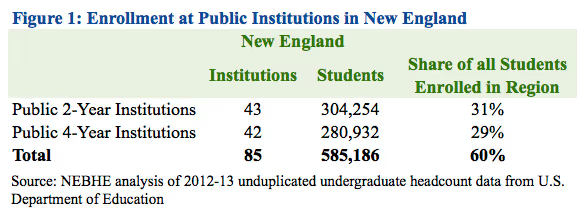
New England’s public institutions serve a majority of the region’s college students—60%, or nearly 600,000 undergraduates, in academic year 2012-13 (Figure 1).
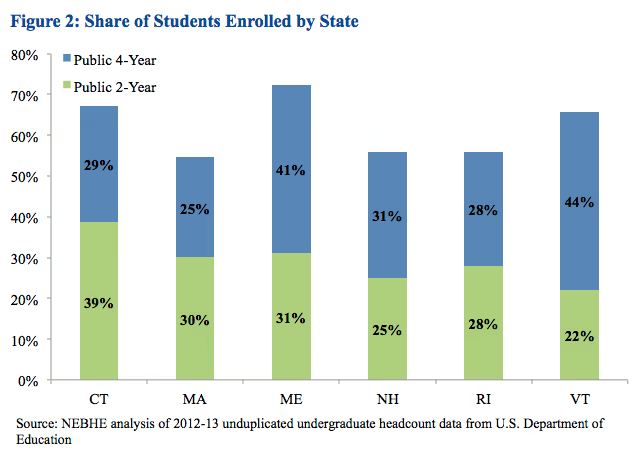
Across states, the breakdown of enrollments varies across sectors (Figure 2).
Prices of public higher education rose dramatically since the beginning of recession.
This academic year (2014-15), average published tuition and mandatory fees for a year of full-time study in New England is $4,581 at public 2-year institutions and $10,299 at public 4-year institutions (Figure 3).
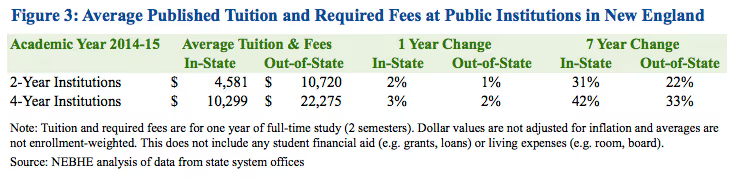
Prices for both sectors are well above the U.S. averages of $3,508 for 2-year institutions and $8,471 for 4-year institutions. Yet tuition increases in New England’s 2-year sector have been slower over the past seven years than nationwide, showing promise for the region’s community colleges—a crucial access point for residents.
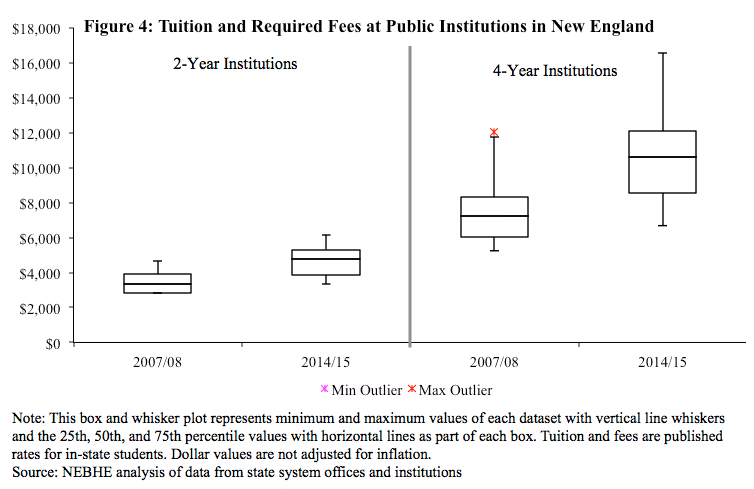
Price increases varied across public 2-year and 4-year sectors (Figure 4). With a greater diversity of institutions in the 4-year sector (online-only, bachelor’s-, master’s-, doctorate-granting), the range of lower- and higher-priced options is larger, and the change in median tuition and mandatory fees (the solid black line in the middle of each box in Figure 4) is more substantial.
These changes disproportionately impacted low-income families.
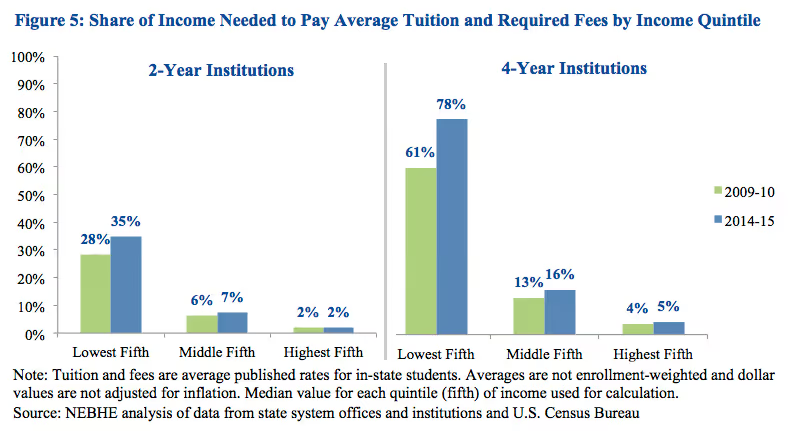
Over the past five years, published tuition prices have risen faster than household income, leaving most New England families to direct a larger share of their income to pay for college. (Figure 5)
Of course, not all students rely on family income to pay for college. The majority of students seek some kind of financial aid—81% of students filed a Free Application for Federal Student Aid (FAFSA) in 2014, according to a recent Sallie Mae survey. Financial aid lowers the share of income needed to pay tuition, though this varies significantly between students and institutions. While individual student financial aid packages vary, at least one financial aid program is fairly easy to predict and summarize: the federal Pell Grant. Receiving the maximum Pell Grant award would lower the lowest quintile’s share of income needed to 0% at 2-year institutions and 35% at 4-year institutions (Figure 6).
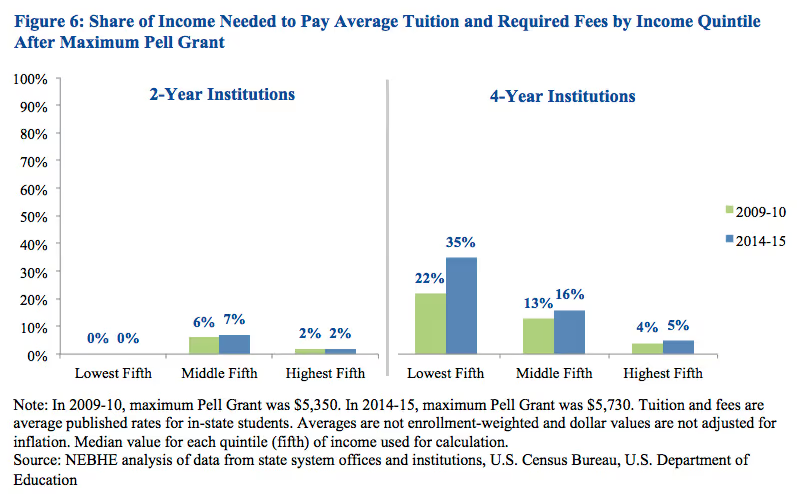
The stark difference in cost burden on the lowest quintile of households after including the maximum Pell Grant speaks volumes to the power of financial aid. When funded and targeted effectively, grants and scholarships can level the playing field between high- and low-income students in terms of share of income needed to pay tuition and fees. In fact, many New England states are currently investigating how to maximize the effectiveness of their own financial aid programs through NEBHE’s Redesigning Student Aid in New England project, legislative study commissions and other efforts.
Financial aid alone, however, may be an unsustainable solution to addressing affordability concerns in the region. Transformative change in costs and prices passed on to students is needed if public institutions aim to continue as New England’s affordable, most accessible pathway to a postsecondary credential.
Recent attempts to revolutionize paying for college include America’s College Promise, President Obama’s recent proposal to make community or technical college “as free and universal as high school,” the Tennessee Promise scholarship, the City University of New York’s holistic ASAP program, and Pay It Forward proposals. NEBHE’s Higher Education Innovation Challenge goes directly after institutional cost issues. The country is on the precipice of bold, groundbreaking action; New England states have the chance to lead the way.
As a data-rich companion to On Affordability, please see the 2014-15 Public Tuition and Fees Data Supplement, which provides a portfolio of figures that track and examine tuition and fees for both the region overall and each New England state.
Gretchen Syverud is a policy research analyst at NEBHE.