Blog Content


September 24, 2019
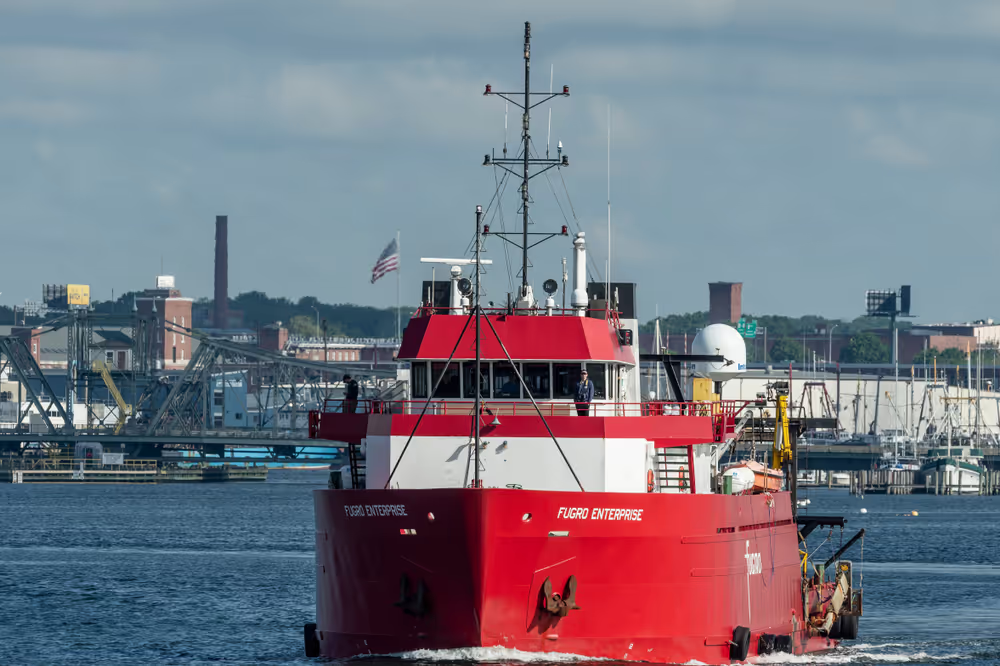
“It is an interesting biological fact that all of us have, in our veins the exact same percentage of salt in our blood that exists in the ocean, and, therefore, we have salt in our blood, in our sweat, in our tears. We are tied to the ocean.” —President John F. Kennedy, Sept. 14, 1962, Newport, R.I.
Half a century after President Kennedy made those remarks, our collective future as a planet, as regions, and as communities is tied closer to the ocean than ever before. There is a fast-emerging consensus—at the global, national and local levels—that the ocean, which covers two-thirds of the Earth’s surface, offers real economic opportunity beyond the centuries-old industries of commercial fishing and shipping, but also imposes a solemn obligation to protect it and coastal environments from rapid degradation.
“The blue economy concept seeks to promote economic growth, social inclusion and the preservation or improvement of livelihoods while at the same time ensuring environmental sustainability of the oceans and coastal areas,’’ states the World Bank’s 2017 report, The Potential of the Blue Economy.
The Organization for Ocean Cooperation and Development projects that from 2010 to 2030, the blue economy will double in size to $3 trillion and account for 40 million jobs worldwide. The National Oceanic and Atmospheric Administration reports that coastal counties (not including Alaska) comprise just 10% of the U.S. land mass, they are home to 40% of the population.
Leaders in government, industry and academia along the SouthCoast of Massachusetts, Cape Cod and Rhode Island now understand that we have a once-in-a-century opportunity to reinvent our own coastal economic ecosystem and set an example for other communities around New England and the nation.
UMass Dartmouth is leading a regional effort funded by the U.S. Economic Development Agency, area banks and the Commonwealth of Massachusetts to grow a marine technology corridor that spans I-195 from Narragansett Bay, through the urban centers of New Bedford and Fall River, and across the Cape Cod Canal.
Massachusetts Congressman Bill Keating, whose district includes the nation’s leading fishing port in New Bedford and the prime seaside tourist destination of Cape Cod, is pushing for the subregions on both sides of the Cape Cod Canal to collaborate. Congressman Joe Kennedy, whose Massachusetts district borders Rhode Island, has called on leaders on both sides of the state line to leverage their economic and cultural affinities.
The Fall River and New Bedford Chambers of Commerce, rivals for decades, recently announced plans to formally integrate as the SouthCoast Chamber, essentially one chamber representing the interests of 1,600 businesses from the Rhode Island state line to the Cape Cod Canal.
The first step in building our regional blue economy is a UMass Dartmouth Public Policy Center analysis of the marine technology industry to be released this fall. Step two will be a coordinated engagement of marine technology firms in the development of a real strategy to grow their industry in our region. This will include marketing the region as fertile ground to grow marine technology enterprises.
These efforts illustrate a new belief that it is better to grow the region’s economic pie so that all can eat rather than fighting over the slices.
The cornerstones of a vibrant regional blue economy exist and are ready to be built upon:
Tangible signs of progress abound. A long-dormant, 14-acre parcel of waterfront property in New Bedford was just purchased to be redeveloped as a shipbuilding facility. Just 20 miles away at Somerset’s Brayton Point, Anbaric has announced plans to invest $645 million in a waterfront energy conversion and storage facility.
UMass Dartmouth’s School for Marine Science and Technology is leading research related to the impacts of offshore wind development on commercial fishing, and recently completed an analysis of how commercial fishing ports will need to adapt to the movement of fish stocks due to climate change.
The next steps need to be:
The SouthCoast, Cape Cod and Rhode Island as a region must come together to create a hub of innovation and entrepreneurship in the Blue Economy to create the next wave of business development in the Northeast.
Robert E. Johnson is the chancellor of the University of Massachusetts Dartmouth.